Blog
September 24, 2026
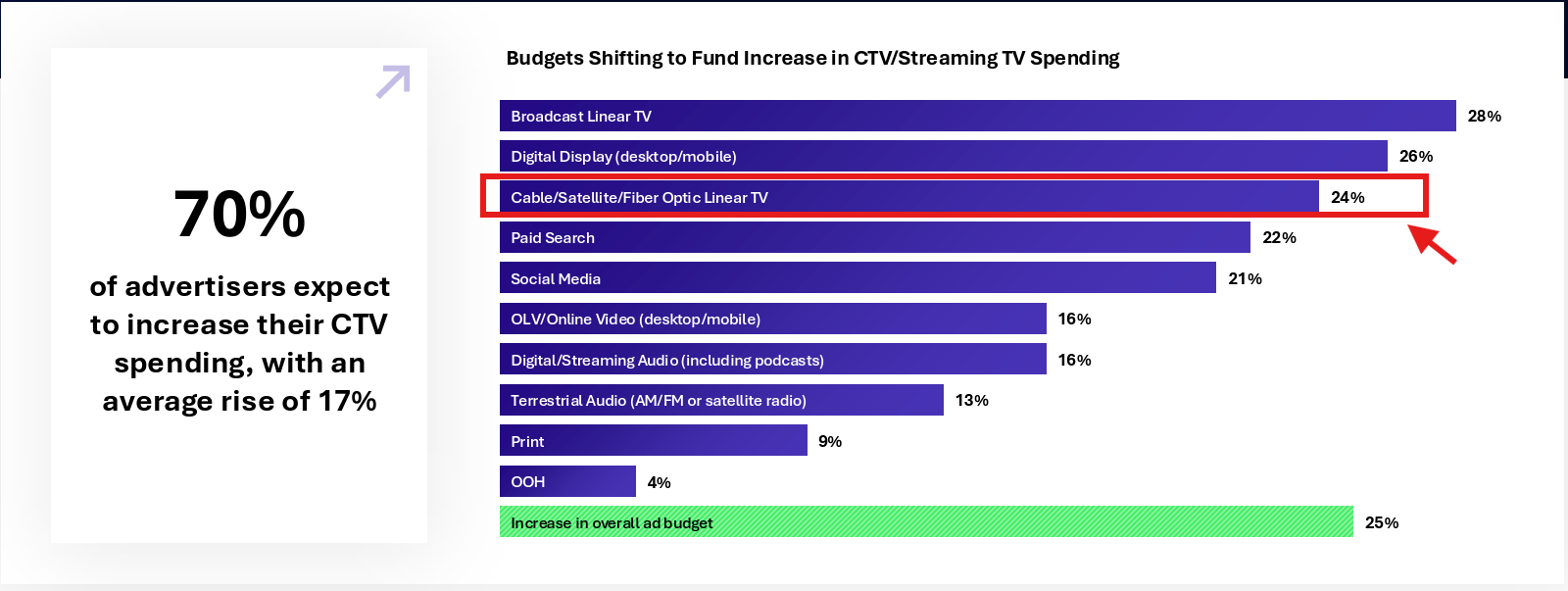
A recent survey of advertisers found that 7 in 10 plan to increase over-the-top (OTT) or connected TV (CTV) spending by 17% in 2026. Makes sense when CTV viewing showed a 46% increase in the second quarter of 2025.
But should you invest all your ad budget in both? Or is there a difference in running ads in OTT vs CTV?
Quick answer: OTT is how content is delivered (via the internet), while CTV is the “OTT content” streamed on a TV screen. The difference might seem small, but it directly affects how you reach audiences and manage ad budgets.
In this article, we’ll go into the differences in-depth so you can use both effectively for streaming and advertising.
Over-the-top (OTT) streaming means delivering video content directly over the internet. In other words, you bypass traditional cable or satellite providers.
And there’s a lot of bypassing going on. The earlier survey shows that advertisers are shifting 24% of their linear TV budgets (cable, satellite, fibre) into OTT and CTV.
The reason for the shift is that OTT offers clear advantages:
That’s why OTT platforms like Netflix, Amazon Prime Video, and YouTube continue to grow. And you can (and should) make a shift from Linear TV to OTT as well. Simplestream makes the process easy; it handles everything from content delivery, through monetisation to analytics. All in one place.
Connected TV (CTV) refers to television screens that stream OTT content.
This includes smart TVs and devices like streaming sticks or gaming consoles connected to a TV. And they have some significant perks.
Popular CTV platforms include devices and ecosystems like Roku, Amazon Fire TV, and Apple TV.
OTT is the delivery method, while CTV is the device used to consume that content. Here’s the side-by-side comparison:
Below, we discuss the differences extensively across several factors.
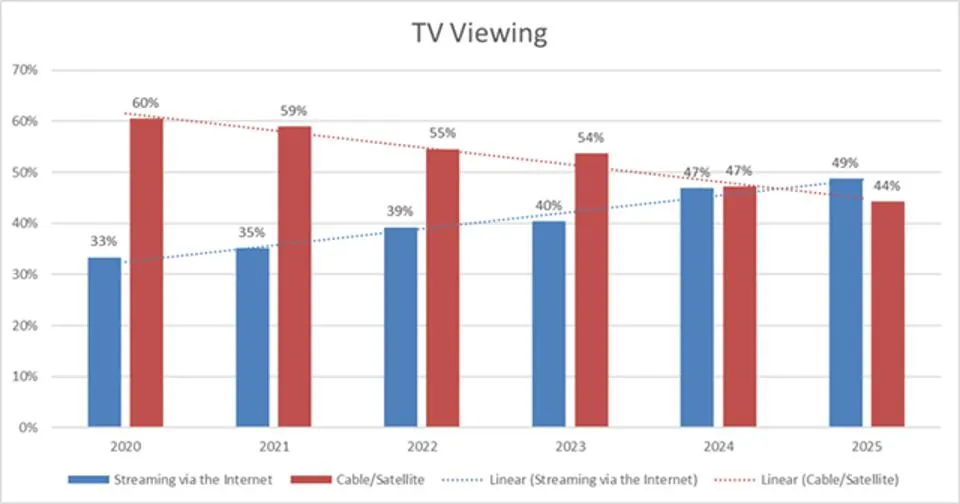
People watch content in different ways, one of which is streaming. And it has grown, from 33% in 2020 to 49% in 2025.
Hence, broadcasters must understand how ads in OTT and CTV work to cut waste.
OTT platforms support different ad formats. For example, you can do pre-roll, mid-roll, and post-roll video ads. This means that you can add your ad at the beginning, middle, or end of the content. There are also interactive ad formats like clickable overlays and pause ads. And since OTT works on various devices such as phones and desktops, it’s easy to be flexible with your ad.
CTV ad formats, on the other hand, are more like a traditional TV experience. Most of the ads are full-screen video spots that run for 15, 30, or 60 seconds. They are often delivered in ad pods (many ads back-to-back), like linear TV breaks. And they are usually not interactive.
OTT platforms, especially on mobile and desktop, make it easy for users to engage directly. Users can take actions such as clicking, swiping, tapping, or exploring ads. This makes formats like interactive overlays and clickable CTAs more effective. Hence, OTT is best when you want users to take immediate actions (e.g., sign up).
CTV, however, provides a lean-back experience. You can only interact with remote controls except for platforms that support QR codes or voice-enabled actions. This affects immediate engagement, and many ads may end up getting passive views. Because of limited interaction, CTV is best for brand awareness. That is, when you want to reach or remind your target audience about your brand.
Since many OTT platforms are personal devices, viewing can be more fragmented. This means scattered users' attention as they may multitask, switch apps, or skip ads. So advertisers need to capture attention fast and keep messaging concise.
In contrast, CTVs are on larger screens, and viewers can be more relaxed and engaged, with fewer distractions. As a result, ads can be longer, high-quality, and designed for storytelling rather than quick conversions.
💡Pro tip: OTT ads need to be quick and easy to understand, while CTV ads can be more polished and tell a longer story. Meaning, as a broadcaster, you must match your ad style to people's viewing behaviour.
OTT and CTV serve different goals, so you’ll have to choose based on what you want to achieve.
However, I recommend mixing both to cover the full marketing funnel. Use OTT for direct response and CTV for scale and storytelling.
💡Pro tip: CTV or OTT, viewers often hit pause while watching videos. That leaves a window for monetisation through Pause Ads.
OTT and CTV have their key advantages depending on your goal. However, both help reach modern streaming audiences better.
When you want to run ads that you can control (with flexible options) and track their outcomes, OTT is perfect. It gives you more control over who sees your content and how they engage with it. Plus, you can reach your viewers wherever they are since the devices are handy.
Key benefits:
CTV stands out when the goal is scale, attention, and brand impact. It combines the reach of traditional TV with improved targeting and digital measurement.
Key benefits:
Further reading: How to acquire news customers in OTT
There are limitations advertisers must know to make the most of their ad campaigns. Here are a few:
People having options to view content on various devices can lead to fragmentation, especially in OTT. This can lead to two things:
As a result, you’ll have to work with different ad servers and measurement tools. You also need to meet multiple platform requirements. All these increase operational complexity.
Each platform tracks data differently, so it’s not easy to get a clear view of performance. This makes it difficult to compare campaigns or see what is actually working.
Consider working with tools, like Simplestream, that can bring this data into a simple, consistent view.
OTT and CTV are not immune to ad fraud. There can be issues like invalid traffic, which may lead to wasted ad spend. And because of the intermediaries involved, it’s not always easy to verify where ads are shown or whether the traffic is real.
Another issue is ads appearing alongside content that doesn’t match a brand’s values. This is not safe for the brand, especially if the ad appears on open or less-controlled platforms.
There are no consistent measurement standards for OTT and CTV. This is because different platforms use their own methods, which makes results hard to compare. For example, what counts as a “view” or “completion” can vary across providers.
This leads to gaps in attribution. It’s difficult to connect ad exposure to outcomes like purchases or sign-ups, especially across devices. As a result, proving ROI can be unclear.
To fix this, broadcasters need shared metrics they all agree on, and a simple way to track performance on different platforms.
Ads can become expensive, especially as demand grows. And it gets harder to stay within budget as expenses like premium inventory and platform costs add up. In some cases, advertisers may even pay more and still not see a clear increase in results.
Also, if you do not plan well, your ads can appear too often to the same user or the wrong audience. This will reduce the effectiveness of your ad campaign.
But you can manage this with better budgeting and management. Always track your ads and optimise them when necessary so that every impression delivers value.
Also read: Common challenges of CTV and how to fix them!
Measuring OTT vs CTV performance comes down to reach, engagement, and outcomes. While the signals may differ slightly across devices, the metrics to track are constant.
Simplestream unifies these metrics for advertisers. It offers real-time analytics, ad performance tracking, and audience insights across OTT and CTV environments. For example, it did something for Virgin Media Television.
The enterprise broadcaster needed:
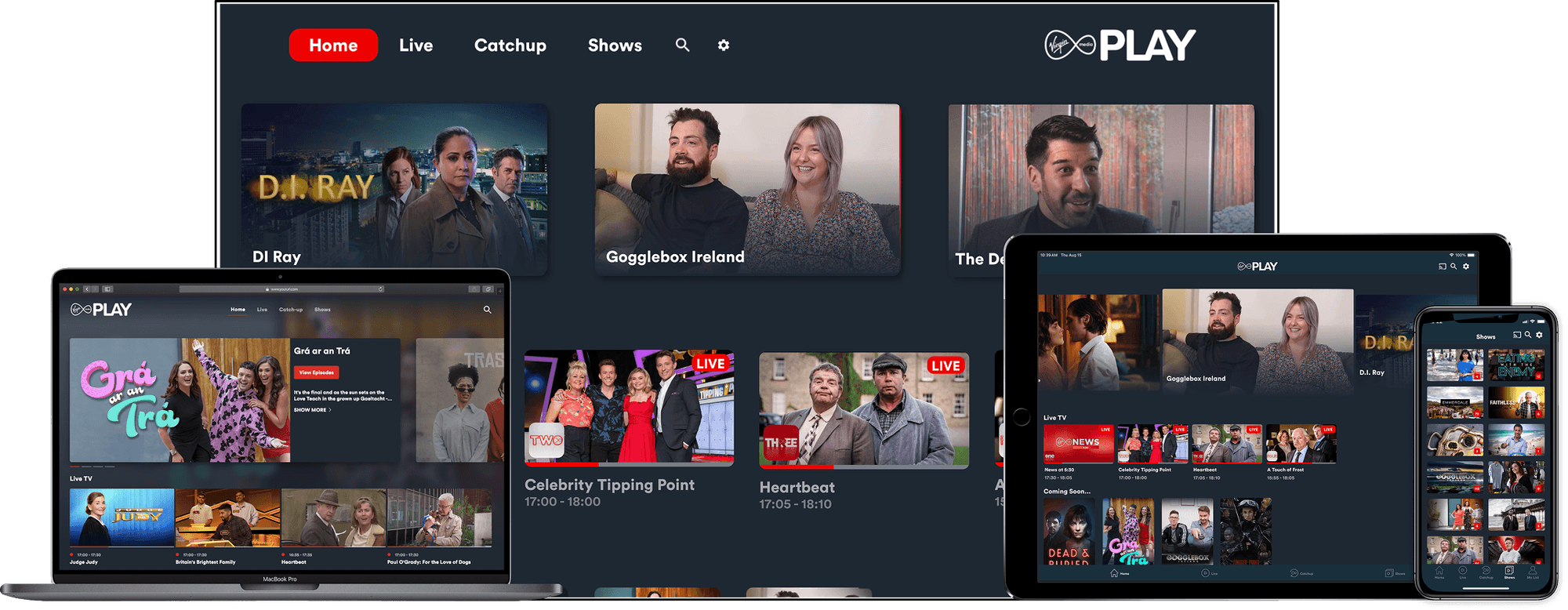
Using Simplestream, they implemented a unified OTT platform that handled content delivery, monetisation, and real-time analytics. This gave their team clearer visibility into campaign performance and user engagement across devices.
Yvonne Doyle, Director of Operations at Virgin Media Television, said:
“By leveraging Simplestream's advanced technology in the OTT space, we have been able to build a streaming service that is future-proofed and meets the high expectations of today’s viewers and opens up new avenues for revenue growth.”
Need a similar solution? Get in touch!
Understanding OTT vs CTV is only step one. You still need a strategy and precise execution.
Simplestream can help with visibility and management. Use it to launch, manage, and monetise streaming across OTT and CTV. All in one unified platform.
Book a demo now to explore how it works!
Yes. CTV is a subset of OTT. OTT delivers content over the internet, while CTV refers specifically to OTT content viewed on internet-connected TV screens.
It depends. OTT is better for cross-device targeting and performance tracking, while CTV delivers higher engagement and premium, big-screen ad experiences for brand campaigns.
According to Statista, it is currently $352.96bn and projected to be $482.76bn by 2030. The users are growing equally. Statista estimates 5.11bn users by 2030. All these mean now is the best time to start OTT and CTV, if you haven’t.
Yes. OTT content can be consumed on mobile, desktop, or tablet without a TV. CTV is just one of the devices within the OTT ecosystem.
Because it performs. CTV combines TV-scale reach with digital targeting, often leading to higher completion rates and stronger brand recall compared to smaller-screen ads.